


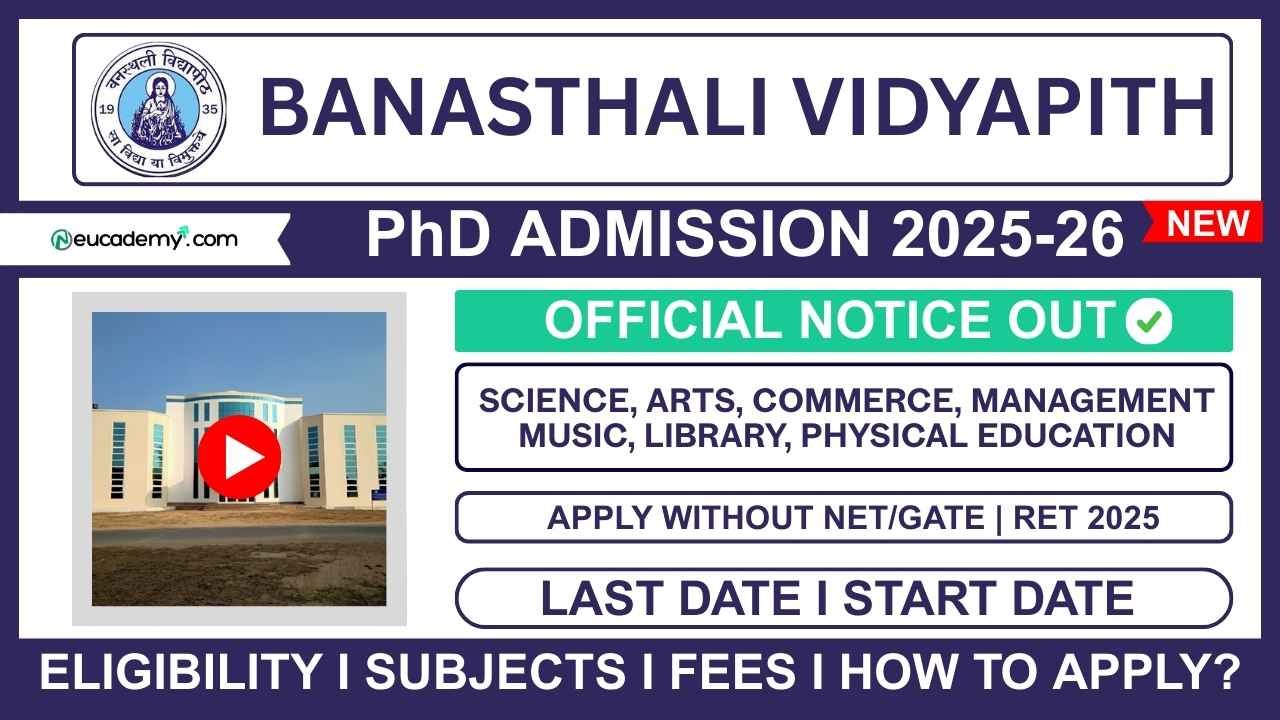
Banasthali Vidyapith PhD Admission 2026-27: Ultimate Guide & Exciting Notification.
Introduction to Banasthali Vidyapith PhD Admission 2026-27
The Research Entrance Test (RET) notification for admission to the Ph.D. program at Banasthali Vidyapith has been released for the Academic Year 2025-26 (Batch – January 2026). This is an exciting opportunity for scholars aiming to pursue doctoral research at one of the top women’s universities globally. Banasthali Vidyapith holds the highest possible ‘A++ Grade’ by NAAC and is consistently ranked among the top institutions by NIRF. Interested candidates must register for the RET to qualify for the **Banasthali Vidyapith PhD Admission 2026-27**. The admission process is highly competitive and is based on combined merit.
See Ongoing PhD AdmissionTable of Contents
Important Dates for RET & Admission
Candidates seeking **Banasthali Vidyapith PhD Admission 2026-27** should note the following critical deadlines for the January 2026 batch:
| Particulars | Dates (Batch: January 2026) |
|---|---|
| Last Date for Submission of Research Entrance Test (RET) Form | 14 December, 2025 |
| Date and Time of Research Entrance Test (RET) | 21 December, 2025 (11:00 AM to 01:00 PM) |
| Date of Course Work Examination (CSW) | 21 December, 2025 (02:00 PM to 04:00 PM) |
| Declaration of List of Shortlisted Candidate for Interview | 24 December, 2025 |
| Date of Interview | 31 December, 2025 to 12 January, 2026 |
| Declaration of List of Shortlisted Candidate for Admission | 15 January, 2026 |
Disciplines and Research Areas for Banasthali Vidyapith PhD Admission 2026-27
The Vidyapith invites applications for the Ph.D. program across a wide range of departments. The following table details the available disciplines and their corresponding research areas:
| Name of Department | Associated Research Areas |
|---|---|
| Architecture & Planning | Architecture & Planning, Structural Engineering |
| Artificial Intelligence (AI) | Artificial Intelligence (AI) |
| Automation | Electrical Engineering, Robotics, Automation, Control & Instrumentation, Mechanical Engineering |
| Bioscience and Biotechnology | Agriculture (Plant Breeding & Genetics), Applied Microbiology and Biotechnology (AMBT), Biochemistry, Bioinformatics, Bio-Medical, Bioscience, Bioscience (Plant Science), Bioscience (Animal Science), Biotechnology, Botany, Zoology |
| Chemical Engineering | Chemical Engineering, Fuel Engineering |
| Chemistry | Chemistry |
| Commerce and Management | Commerce, Management, Aviation Management |
| Computer Science | Computer Science, Computer Science & Engineering, Software Engineering, Information Technology |
| Data Science | Data Science |
| Design | Design, Fashion Design, Fashion Technology, Applied Art, Interior Design, Textile Design, Commercial Art, |
| Earth Sciences | Environmental Science, Geography, Geology, Remote Sensing |
| Economics | Economics |
| Education | Education |
| English and Modern European Languages | English, French, German |
| Hindi and Modern Indian Languages | Hindi |
| History and Indian Culture | History |
| Home Science | Home Science (Clothing & Textile), Home Science (Extension and Communication), Home Science (Food Science & Nutrition), Home Science (Human Development), Home Science (Resource Management) |
| Journalism and Mass Communication | Journalism and Mass Communication, Mass Communication |
| Legal Studies | Law |
| Library & Information Science | Library & Information Science |
| Mathematics & Statistics | Mathematical Science, Mathematics, Statistics, Health Statistics |
| Nursing | Nursing |
| Performing Arts | Music, Dance, Dramatics, Tabla, Performing Art |
| Pharmacy | Pharmaceutical Sciences, Pharmaceutics, Pharmacognosy, Pharmacology, Pharmacy, Industrial Pharmacy, Medicinal Chemistry, Pharmaceutical Chemistry, Pharmaceutical Quality Assurance |
| Physical Education | Physical Education, Yoga |
| Physical Sciences | Electronics, Electronics & Communication Engineering, Electronics Engineering, Physics, VLSI Design, |
| Political Science and Public Administration | Political Science, Public Administration |
| Psychology | Psychology |
| Sanskrit, Philosophy and Vedic Studies | Philosophy, Sanskrit |
| Sociology | Social Work, Sociology, Women Studies |
| Visual Art | Drawing, Painting, Visual Art, Applied Art, Fine Art, Painting |
Eligibility Criteria for Ph.D.
Aspirants for the **Banasthali Vidyapith PhD Admission 2026-27** must meet the following minimum academic requirements:
- Candidates must have obtained a Master’s degree (1-year/2-semester after a 4-year Bachelor’s or 2-year/4-semester after a 3-year Bachelor’s degree) or an equivalent qualification.
- The minimum aggregate marks required are 55% (or an equivalent CGPA) in the Master’s degree.
- A relaxation of 5% (to 50%) is allowed for candidates belonging to SC/ST/Differently-Abled/EWS categories.
- Candidates with a 4-year/8-semester Bachelor’s degree directly applying must have a minimum of 75% marks in aggregate (70% for reserved categories).
- Candidates who have qualified for NET, SLET, GATE, GPAT, or M.Phil. with 55% (admitted through entrance exam) may be exempted from the Research Entrance Test (RET).
Admission Procedure & Exam Pattern
Admission is based on a Research Entrance Test (RET) followed by an interview, unless the candidate qualifies for exemption.
Research Entrance Test (RET) Details
- RET Requirement: Every candidate must appear in the RET, except for those applying to the Department of Performing Arts, Visual Art, Design and Architecture, and candidates exempted via national-level tests (NET, GATE, etc.).
- Exam Mode & Duration: The RET is conducted Online, and the duration is 2 Hours (11:00 AM to 01:00 PM).
-
Paper Pattern: The test consists of 100 multiple-choice questions (MCQs), all carrying equal marks.
- 50 questions on Research Aptitude.
- 50 questions on the Relevant Subject.
- Passing Criteria: The qualifying marks for the entrance test are 50%. A relaxation of 5% (to 45%) is provided for SC/ST/Differently-Abled category candidates.
- Negative Marking: There is No Negative Marking in the RET.
Selection Process
The final merit list for admission to the Ph.D. program is determined by combined scores:
- 70% weightage is given to the marks obtained in the entrance test (or NET scores for exempted candidates).
- 30% weightage is given to the marks obtained in the interview/viva voce.
Course Work Examination (CSW)
The CSW is a mandatory requirement for continuation in the program and consists of 40 MCQs in every paper, covering topics such as Research Methodology, IT Based Research Techniques, and Research and Publication Ethics (RPE). A minimum of 55% marks (or equivalent grade) is required in the course work.
Examination Fee Structure
The following is the fee structure for the Research Entrance Test (RET) and Course Work Examination (CSW), effective from May 1, 2023.
| Particulars | Examination Fee |
|---|---|
| Examination Fee for Research Entrance Test (RET) | Rs. 1500/- |
| Examination Fee for Course Work (CSW) | Rs. 1500/- |
Important Admission Note
The Academic Office will not entertain requests for admission after 15 days from the declaration of the list of shortlisted candidates. Seats will automatically be transferred to the next waiting aspirants.
For detailed instructions and official information regarding **Banasthali Vidyapith PhD Admission 2026-27**, please refer to the official documents:
View PhD Notification | View PhD Instructions | View RET Fee Notice (PDF)