


- 📋 Overview: How to Use This Book List
- 🎯 Question-Driven Strategy
- Unit 1 — Structure and Function of Biomolecules
- Unit 2 — Cellular Organization
- Unit 3 — Fundamental Processes
- Unit 4 — Cell Communication and Cell Signaling
- Unit 5 — Developmental Biology
- Unit 6 — System Physiology – Plant
- Unit 7 — System Physiology – Animal
- Unit 8 — Inheritance Biology
- Unit 9 — Evolution and Diversity of Life Forms
- Unit 10 — Ecology and Behavioural Biology
- Unit 11 — Bioinformatics and Computational Biology
- Unit 12 — Biochemical Engineering and Industrial Biotechnology
- Unit 13 — Advances in Biotechnology
- Unit 14 — Methods in Biology
- 📝 CSIR NET PYQ Book (2015–2025)
- ❓ Frequently Asked Questions
Overview: How to Use This Book List
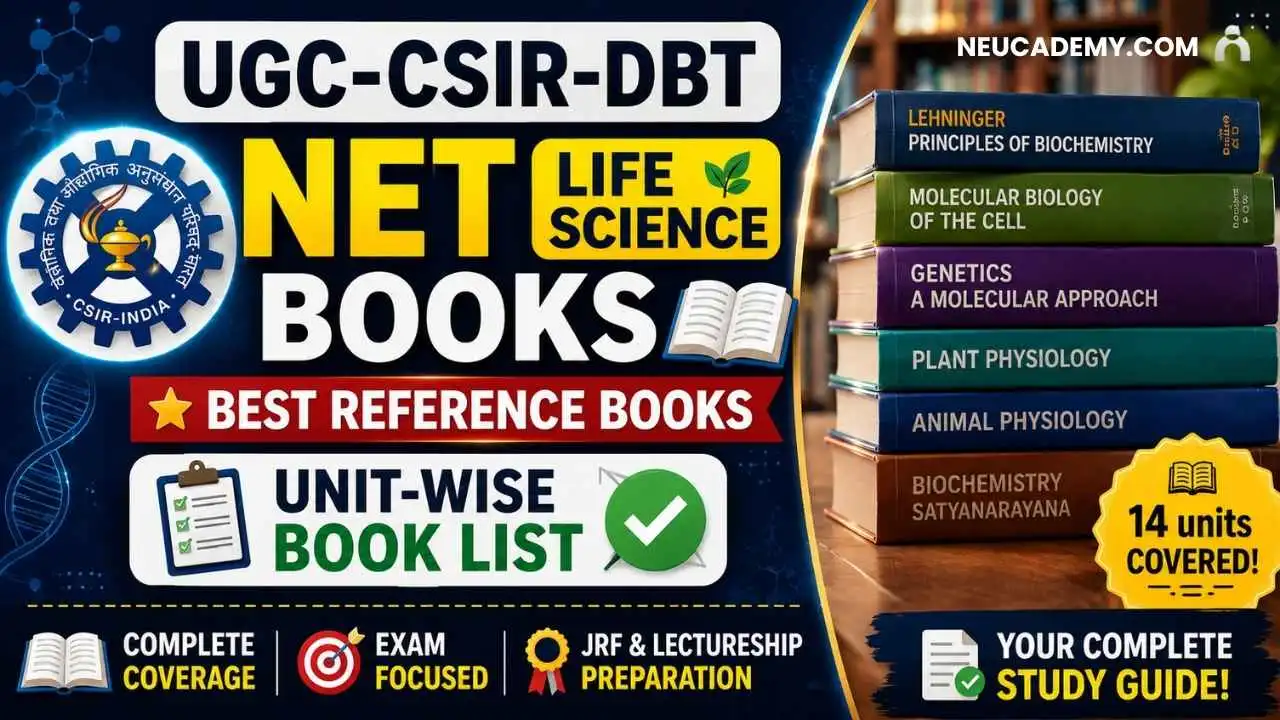
This comprehensive book list has been curated specifically for the UGC-CSIR-DBT NET-JRF Life Science Examination 2026. The books are organized unit-wise as per the latest syllabus to help you prepare strategically.
Standard Textbook
Advanced Reference
Methods Book
Problem-Solving Resources
Instant Notes / Concise Books
Advanced Text + PYQs
Question-Driven Strategy: How to Choose a Book
Do not study every book listed. Different books are useful for different purposes. Your selection should be driven by the challenges you face.
Syllabus → Concept → Textbook → Questions → Identify Weakness → Reference Book → Practice → Revision. This is far more effective than reading from cover to cover.
| Your Situation | Recommended Approach |
|---|---|
| 🔰 Beginner (First Read) | Choose one strong textbook per subject + revision book + PYQ book |
| 📈 Strong Fundamentals | Advanced references + problem-solving resources + methods books + PYQs |
| 🎯 Part C Focus | Mechanisms + experiments + data interpretation + PYQs (especially 2024–2025) |
| ⏰ Exam Approaching | Revise core concepts → solve PYQs → identify weak areas → refer to specific sections → practice analytical questions |
Structure and Function of Biomolecules
For Conceptual Questions: Use Lehninger Principles of Biochemistry.
For Deeper Mechanisms (e.g., enzyme kinetics, regulation): Use Voet & Voet or Stryer.
For Plant-Specific Biochemistry: Use Heldt & Piechulla.
| Book Name | Best For | Buy | |
|---|---|---|---|
| Lehninger Principles of Biochemistry — Nelson & Cox | Fundamental Concepts | Buy | |
| Biochemistry — Voet & Voet | Advanced Mechanisms | Buy | |
| Biochemistry — Berg, Tymoczko & Stryer | Alternative Explanations | Buy | |
| Enzymes: Biochemistry, Biotechnology — Palmer & Bonner | Enzyme Kinetics | Buy | |
| Plant Biochemistry — Heldt & Piechulla | Plant Biochemistry | Buy | |
| Biochemistry: Instant Notes — Hames & Hooper | Rapid Revision | Buy |
Cellular Organization
For Core Cell Structure & Function: Use Molecular Biology of the Cell (Alberts).
For Molecular Mechanisms: Use Molecular Cell Biology (Lodish).
For Microbial Cell Structure: Use Prescott's Microbiology or Brock.
| Book Name | Best For | Buy | |
|---|---|---|---|
| Molecular Biology of the Cell — Alberts et al. | Core Concepts | Buy | |
| Molecular Cell Biology — Lodish et al. | Molecular Mechanisms | Buy | |
| Cell and Molecular Biology — Gerald Karp | Conceptual Explanations | Buy | |
| Microbiology — Prescott | Microbial Cell Organization | Buy |
Fundamental Processes
For Core Molecular Biology: Use Watson's Molecular Biology of the Gene.
For Advanced Gene Regulation Topics: Use Lewin's GENES.
| Book Name | Best For | Buy | |
|---|---|---|---|
| Molecular Biology of the Gene — Watson et al. | Core Concepts | Buy | |
| Lewin's GENES — Krebs et al. | Advanced Regulation | Buy | |
| BIOS Instant Notes in Molecular Biology | Rapid Revision | Buy |
Cell Communication and Cell Signaling
For Core Signaling Mechanisms: Use Alberts or Lodish.
For Immunology Signaling: Use Kuby Immunology.
| Book Name | Best For | Buy | |
|---|---|---|---|
| Molecular Cell Biology — Lodish et al. | Signaling Mechanisms | Buy | |
| Immunology — Kuby | Immune Signaling | Buy |
Developmental Biology
| Book Name | Best For | Buy | |
|---|---|---|---|
| Developmental Biology — Scott F. Gilbert | Core Concepts & Model Organisms | Buy | |
| Principles of Development — Lewis Wolpert | Mechanisms & Principles | Buy |
System Physiology – Plant
| Book Name | Best For | Buy | |
|---|---|---|---|
| Plant Physiology — Taiz & Zeiger | Core Physiology | Buy | |
| Plant Biochemistry — Heldt & Piechulla | Biochemical Pathways | Buy |
System Physiology – Animal
| Book Name | Best For | Buy | |
|---|---|---|---|
| Ganong's Review of Medical Physiology | Core Medical Physiology | Buy | |
| Medical Physiology — Guyton & Hall | Detailed Physiology | Buy |
Inheritance Biology
For Core Concepts & Problems: Use Snustad & Simmons or Pierce.
For Gene Manipulation: Use Primrose & Twyman.
| Book Name | Best For | Buy | |
|---|---|---|---|
| Principles of Genetics — Snustad & Simmons | Core Genetics | Buy | |
| Genetics: A Conceptual Approach — Pierce | Conceptual Understanding | Buy |
Evolution and Diversity of Life Forms
Ecology and Behavioural Biology
| Book Name | Best For | Buy | |
|---|---|---|---|
| Fundamentals of Ecology — Odum | Core Ecological Concepts | Buy | |
| Elements of Ecology — Smith & Smith | Modern Ecological Concepts | Buy |
Bioinformatics and Computational Biology
| Book Name | Best For | Buy | |
|---|---|---|---|
| Bioinformatics: A Practical Guide — Baxevanis & Ouellette | Practical Tools & Analysis | Buy | |
| Introduction to Bioinformatics — Lesk | Conceptual Understanding | Buy |
Biochemical Engineering and Industrial Biotechnology
| Book Name | Best For | Buy | |
|---|---|---|---|
| Principles of Fermentation Technology — Stanbury et al. | Fermentation & Bioreactors | Buy | |
| Industrial Microbiology — Casida | Industrial Microorganisms | Buy |
Advances in Biotechnology
Methods in Biology
This unit is critical for experimental and application-based questions.
| Book Name | Best For | Buy | |
|---|---|---|---|
| Principles and Techniques of Biochemistry — Wilson & Walker | General Methods | Buy | |
| Biophysical Chemistry — Upadhyay | Biophysical Techniques | Buy |
CSIR NET Life Science PYQ Book (2015–2025)
🚨 Most Important Resource for Part B & Part C Preparation
No book list is complete without a dedicated Previous Year Questions (PYQ) book.
Solving PYQs is the single most effective way to understand the exam pattern, difficulty level, and the type of analytical questions asked in CSIR NET.
| Book Name | Coverage | Best For | Buy | |
|---|---|---|---|---|
| CSIR NET Life Science PYQ Book — Previous Year Solved Papers with Detailed Solutions (2015 to June 2025) | 2015 – June 2025 (All Shifts) |
Part B & Part C Practice • Understanding question trends • Time management • Identifying weak areas • Application-based practice | Buy Now |
- Stage 1 (Concept Building): Use textbooks to learn concepts. Don't attempt PYQs until you have basic understanding.
- Stage 2 (Topic-Wise Practice): After completing a unit, solve the PYQs from that unit to test your understanding.
- Stage 3 (Full-Length Mocks): Attempt full papers under timed conditions (3 hours) to simulate the real exam.
- Stage 4 (Analysis): Review every incorrect answer. Understand why you got it wrong — conceptual gap, misreading, or calculation error.
- Stage 5 (Revision): Re-solve difficult questions after revision. Track your progress.
⚠️ Pro Tip: The PYQ book is not a substitute for textbooks — it is a complement. Use it to apply what you have learned.
- Build concepts & fundamentals
- Provide depth & understanding
- Explain mechanisms & pathways
- Test application & analysis
- Reveal exam pattern & trends
- Build speed & accuracy
- Identify weak topics
📚 The Question-Type Book Guide
There is no single "best" book. Match the resource to the question type:
| Question Type | Best Resource Type |
|---|---|
| Basic Factual | Concise Textbook / Revision Book |
| Conceptual | Standard Textbook |
| Mechanism-Based | Advanced Textbook |
| Application-Based / Analytical | Standard + Advanced Reference + PYQs |
| Experimental / Methods | Methods Book (e.g., Wilson & Walker) |
| Numerical / Genetics Problems | Genetics Textbook + Problem Practice |
| Ecology / Population Problems | Ecology Textbook + Problem Practice |
| Part B Preparation | Standard Textbooks + Revision Notes |
| Part C Preparation | Advanced Textbooks + PYQs + Analytical Practice |
| All Types (Practice) | CSIR NET PYQ Book (2015–2025) |
Frequently Asked Questions
No. The purpose of this list is to show you which resource can help with which type of preparation, not to suggest you must purchase every title. A practical library can be much smaller.
Beginners: Choose one strong textbook per subject + one revision book + the PYQ book.
For Part C Focus: Prioritize advanced references, methods books, and the PYQ book for analytical practice.
Not necessarily. For high-weightage or difficult topics, referring to 2-3 books can provide a more comprehensive understanding. However, your main textbook should be your primary resource. Use others to clarify specific weak areas.
Do not start reading large textbooks from scratch. Instead:
- Revise core concepts using your primary notes.
- Solve previous-year questions (PYQs) using the PYQ book.
- Identify weak topics and consult the relevant reference book.
- Practice analytical questions from the latest papers (2024–2025).
Use Instant Notes or concise revision books for a final rapid review.
For Part C, the focus is on application, analysis, and interpretation. Your essential resources are:
- Advanced textbooks for deep understanding of mechanisms.
- Methods books (e.g., Wilson & Walker) for experimental reasoning.
- The CSIR NET PYQ Book (2015–2025) — this is non-negotiable for understanding the question style and practicing application-based problems.
No book list can replace practice with analytical and experimental problems. The PYQ book is your best tool for this.
Not necessarily. Many of these books are available as PDFs (check the PDF column in the tables) or as eBooks. However, having a few key physical books can be helpful for easier reference and note-taking.
Recommendation: The PYQ book is best in physical format for solving papers under exam-like conditions.
Start solving PYQs after you have covered at least 50% of the syllabus. This typically means:
- Months 1-3: Focus on building concepts using textbooks.
- Months 4-6: Start topic-wise PYQ practice alongside continuing new units.
- Months 7-8: Full-length mock tests and analysis.
- Last Month: Revision + solving the most recent 3-4 papers under timed conditions.