


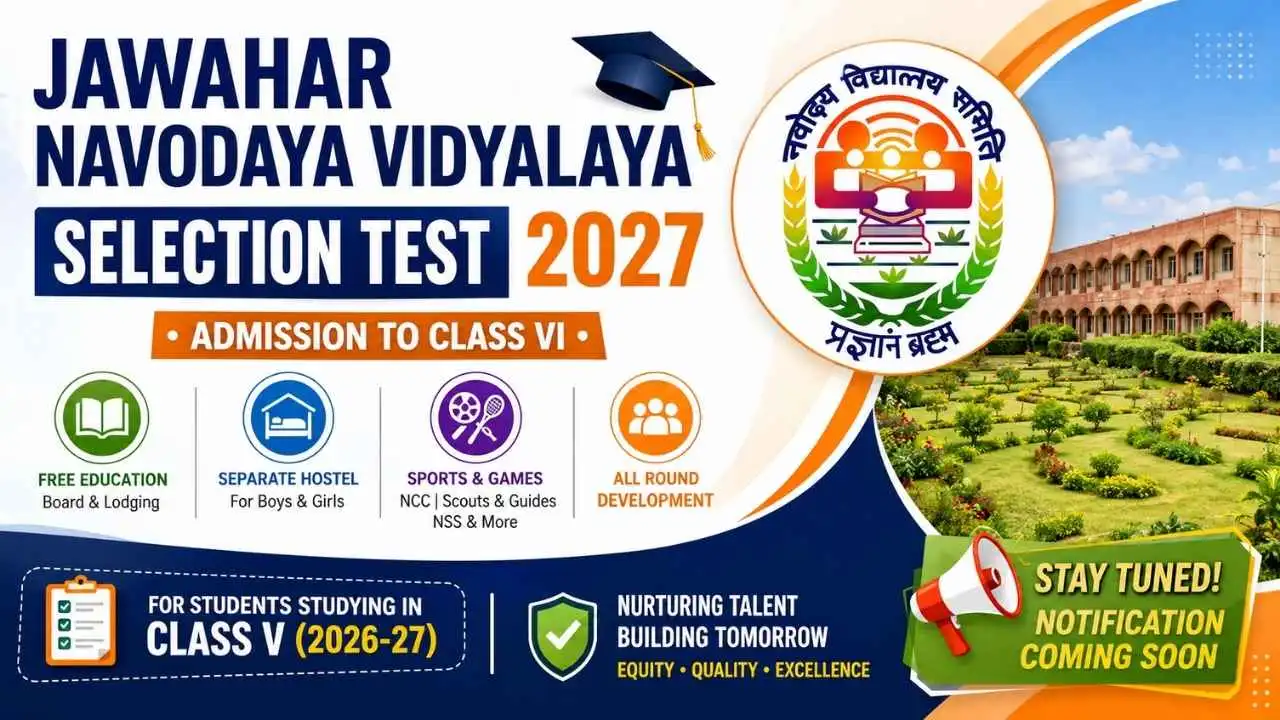
Jawahar Navodaya Vidyalaya Selection Test (JNVST) 2027-28 for Class 6: Complete Overview
The Jawahar Navodaya Vidyalaya Selection Test (JNVST) 2027 is conducted by Navodaya Vidyalaya Samiti (NVS), an autonomous organization under the Ministry of Education, Government of India, for admission to Class VI in Jawahar Navodaya Vidyalayas (JNVs) for the 2027-28 academic session. JNVs are fully residential, co-educational schools that provide quality education completely free of cost, including boarding, lodging, textbooks, uniforms and other essential facilities, to talented students from across the country.
Admission is offered through a national-level selection test. Eligible students studying in Class V during the academic session 2026-27 can submit their applications online through the official NVS admission portal. Candidates must satisfy all eligibility conditions regarding age, district of residence and educational qualification before applying.
| Particular | Details |
|---|---|
| Exam Name | Jawahar Navodaya Vidyalaya Selection Test (JNVST) 2027 |
| Admission For | Class VI (Session 2027-28) |
| Conducting Authority | Navodaya Vidyalaya Samiti (NVS) |
| Organization | Ministry of Education, Government of India |
| Academic Session | 2027-28 |
| Application Mode | Online |
| Application Fee | Nil (Free) |
| Last Date to Apply | 31 July 2026 |
| JNVST Exam Date | 28 November 2026 |
| Expected Result | By the end of March 2027 |
| Official Website | https://navodaya.gov.in/ |
- Admission into Class VI through JNVST 2027.
- Completely free online application process.
- Free quality education, boarding and lodging for selected students.
- Available for eligible Class V students studying during 2026-27.
- Selection is district-specific as per NVS guidelines.
Table of Contents
JNVST 2027 Important Dates
Candidates planning to appear for the Jawahar Navodaya Vidyalaya Selection Test (JNVST) 2027 should carefully note all important dates released by Navodaya Vidyalaya Samiti. Applications must be submitted before the deadline, and students should regularly check the official website for admit card and other updates.
| Event | Date |
|---|---|
| Online Application Starts | Started |
| Last Date to Submit Application | 31 July 2026 |
| Correction Window | To be notified by NVS |
| Admit Card Release | To be announced |
| JNVST 2027 Examination | 28 November 2026 |
| Expected Result Declaration | By the end of March 2027 |
| Completion of Admission Process | 31 August 2027 (Tentative closing as per prospectus) |
About Jawahar Navodaya Vidyalaya (JNV)
Jawahar Navodaya Vidyalayas (JNVs) were established under the National Policy on Education (1986) by the Government of India to provide quality modern education to talented children, particularly those from rural areas. These schools are administered by the Navodaya Vidyalaya Samiti (NVS), an autonomous organization under the Ministry of Education.
At present, there are 665 functional Jawahar Navodaya Vidyalayas spread across 27 States and 8 Union Territories. A maximum of 80 students are generally admitted to Class VI in each JNV through the Jawahar Navodaya Vidyalaya Selection Test (JNVST), subject to the availability of seats and eligible candidates.
JNVs are fully residential, co-educational schools affiliated with the Central Board of Secondary Education (CBSE). The medium of instruction is the regional language or mother tongue up to Class VIII, after which English is used for Mathematics and Science, while Hindi is used for Social Science.
Students studying in Jawahar Navodaya Vidyalayas receive free education, boarding, lodging, textbooks, uniforms and several other facilities funded by the Government of India.
| Particular | Details |
|---|---|
| School Type | Co-educational Residential School |
| Managed By | Navodaya Vidyalaya Samiti (NVS) |
| Under | Ministry of Education, Government of India |
| Board | CBSE |
| Functional JNVs | 665 |
| Coverage | 27 States and 8 Union Territories |
| Admission Mode | Through JNV Selection Test (JNVST) |
| Approximate Intake | Up to 80 students per JNV (subject to availability) |
Objectives of the Jawahar Navodaya Vidyalaya Scheme
The Jawahar Navodaya Vidyalaya Scheme has been introduced to provide equal educational opportunities to talented children from every district of India, especially those belonging to rural areas. The scheme focuses on quality education, national integration and overall personality development.
- To provide modern, high-quality education with emphasis on academic excellence, culture, values, environmental awareness, adventure activities and physical education.
- To help students develop competency in three languages and strengthen multilingual education.
- To promote national integration through the unique migration programme between Hindi-speaking and Non-Hindi-speaking states.
- To serve as a model institution in every district by improving the overall quality of school education through sharing of experiences and educational facilities.
- Completely residential campus.
- High-quality CBSE education.
- Free boarding and lodging.
- Free textbooks and uniforms.
- Excellent sports facilities.
- NCC, Scouts & Guides and NSS activities.
- National-level exposure through migration programme.
- Focus on leadership, discipline and personality development.
State-wise Distribution of Jawahar Navodaya Vidyalayas
According to the latest prospectus, there are 665 functional Jawahar Navodaya Vidyalayas across India. Additional JNVs have also been sanctioned in districts having higher Scheduled Caste (SC) and Scheduled Tribe (ST) population.
| State / UT | Functional JNVs |
|---|---|
| Uttar Pradesh | 75 + 1 Additional |
| Madhya Pradesh | 51 + 2 Additional + 1 Special |
| Bihar | 38 + 1 Additional |
| Maharashtra | 33 + 1 Additional |
| Rajasthan | 33 + 2 Additional |
| Gujarat | 33 + 1 Additional |
| Odisha | 30 + 1 Additional |
| Karnataka | 30 + 1 Additional |
| West Bengal | 17 + 1 Additional |
| Other States & UTs | As per official prospectus |
| Total | 665 Functional JNVs |
JNVST 2027 Eligibility Criteria for Class 6 Admission
Before submitting the online application, candidates and parents must carefully ensure that all eligibility conditions prescribed by the Navodaya Vidyalaya Samiti (NVS) are fulfilled. Admission to Class VI through JNVST 2027 is strictly based on district-specific eligibility, age, educational qualification and other prescribed conditions. Candidates who fail to satisfy any eligibility requirement may have their candidature cancelled at any stage of the admission process.
| Eligibility Parameter | Requirement |
|---|---|
| Admission Class | Class VI (Session 2027-28) |
| District Eligibility | Candidate should be a bona fide resident of the district for which admission is sought. |
| Schooling | Must be studying Class V during the academic session 2026-27 in a recognized school. |
| School Type | Government, Government Aided, Government Recognized School or NIOS (eligible cases). |
| Date of Birth | Between 01 May 2015 and 31 July 2017 (both dates inclusive). |
| Previous Appearance | Candidate must not have appeared in JNVST earlier. |
| Class III, IV & V | Must have completed one full academic session in each class. |
JNVST 2027 Age Limit
Every candidate applying for Jawahar Navodaya Vidyalaya Selection Test (JNVST) 2027 must satisfy the prescribed age criteria. The same age limit applies to all categories including General, OBC, SC, ST and Divyang candidates.
| Criteria | Date |
|---|---|
| Minimum Date of Birth | 01 May 2015 |
| Maximum Date of Birth | 31 July 2017 |
| Applicable For | All Categories |
Educational Qualification
Candidates must satisfy all educational requirements prescribed in the official JNVST prospectus before applying for admission to Class VI.
- Must be studying Class V during the academic session 2026-27.
- Class V must be studied in a Government, Government-aided or Government-recognized school.
- NIOS candidates possessing the prescribed 'B' Certificate are also eligible subject to NVS rules.
- The candidate must successfully complete Class V before admission.
- Candidates must have studied Classes III, IV and V by spending one complete academic session in each class.
- Candidates who skipped Class III or Class IV are not eligible.
- Candidates who passed Class V in previous academic years cannot apply.
- Students repeating Class V are also not eligible.
District Eligibility Rules
Admission to Jawahar Navodaya Vidyalaya is strictly district-specific. Normally, candidates should apply only for the Jawahar Navodaya Vidyalaya located in the district where they are bona fide residents.
- Application should be submitted only for the district of residence.
- Normally, the candidate should also be studying Class V in the same district.
- If the Class V school is located in a neighbouring district, it must be within the prescribed radial distance from the candidate's residence as allowed by NVS.
- The residence and school location will be verified by Navodaya Vidyalaya Samiti before admission.
- No request for changing the allotted Jawahar Navodaya Vidyalaya after selection will be accepted.
JNVST 2027 Reservation Policy
Navodaya Vidyalaya Samiti follows the reservation policy prescribed by the Government of India to ensure equitable representation of students from different social categories. Reservation is provided for Rural candidates, Scheduled Castes (SC), Scheduled Tribes (ST), Other Backward Classes (OBC), Girls and Divyang (Persons with Disabilities) as per the official guidelines.
| Category | Reservation |
|---|---|
| Rural Candidates | At least 75% of seats in every district. |
| Urban Candidates | Remaining seats filled on merit. |
| Scheduled Caste (SC) | As per district population, subject to Government of India norms. |
| Scheduled Tribe (ST) | As per district population, subject to Government of India norms. |
| Other Backward Classes (OBC) | 27% (Central OBC List only). |
| Girls | Minimum one-third of total seats. |
| Divyang Candidates | Reservation as per Government of India norms. |
Rural and Urban Candidate Eligibility
A major objective of Jawahar Navodaya Vidyalayas is to provide quality education to talented children from rural areas. Therefore, a large percentage of seats are reserved for rural candidates. The Rural or Urban status of a candidate is determined based on the location of the school where Classes III, IV and V were studied.
| Category | Eligibility Requirement |
|---|---|
| Rural Candidate | Must have studied Classes III, IV and V for one full academic session each in Government/Government Aided/Recognized schools located in rural areas. |
| Urban Candidate | If the candidate studied even for a single day in Classes III, IV or V in a school located in an urban area, he/she will be treated as an Urban candidate. |
| NIOS Candidate | Rural/Urban status will be determined according to the residence of the candidate/parent as per NVS rules. |
Documents Required for JNVST 2027 Application
Before starting the online registration, candidates should keep all the required documents ready in the prescribed format. Most documents need to be uploaded in JPG format while filling out the application form.
- Recent passport-size photograph of the candidate.
- Candidate's signature.
- Parent/Guardian's signature.
- Aadhaar Card or Residence Certificate issued by the competent authority.
- Birth Certificate.
- Class V study details.
- APAAR ID (if available).
- PEN Number (if available).
- SC/ST/OBC/EWS certificate (where applicable).
- Divyang/UDID certificate (if applicable).
- File format: JPG/JPEG
- File size: 10 KB to 100 KB
- Photograph should be clear and recent.
- Both candidate's and parent's signatures are mandatory.
Documents Required After Selection
Provisionally selected candidates must produce original documents during admission and document verification at the allotted Jawahar Navodaya Vidyalaya.
- Birth Certificate.
- Residence Certificate.
- Aadhaar Card.
- Study Certificate for Classes III, IV and V.
- Transfer Certificate (TC).
- SC/ST/OBC Certificate (if applicable).
- UDID/Disability Certificate (if applicable).
- Migration Undertaking.
- Any other document required by Navodaya Vidyalaya Samiti.
How to Apply Online for JNVST 2027
The application process for the Jawahar Navodaya Vidyalaya Selection Test (JNVST) 2027 is completely online and free of cost. Parents and candidates should carefully read the official prospectus before submitting the application form. Ensure that all eligibility conditions are satisfied and all required documents are available before registration.
- Visit the official Navodaya Vidyalaya Samiti admission portal.
- Read the complete JNVST 2027 prospectus carefully.
- Select the appropriate State, District and Block.
- Enter candidate's personal and academic details correctly.
- Provide Aadhaar Number or Residence Certificate details.
- Enter APAAR ID and PEN Number (if available).
- Upload the photograph, candidate's signature and parent's signature in JPG format.
- Verify all entered information carefully.
- Submit the application form online.
- Download and save the confirmation page for future reference.
Application Correction Window
After the last date of online application, Navodaya Vidyalaya Samiti opens a correction window for a limited period. During this period, candidates can edit only selected fields permitted by NVS.
| Editable Fields | Status |
|---|---|
| Gender | Editable |
| Area (Rural / Urban) | Editable |
| Category | Editable |
| Disability Status | Editable |
| Medium of Examination | Editable |
JNVST 2027 Admit Card
Admit cards for the Jawahar Navodaya Vidyalaya Selection Test (JNVST) 2027 will be released online before the examination. Candidates can download the admit card free of cost from the official application portal using their registration details.
- Admit card will be available online only.
- No admit card will be sent by post.
- Download and print the admit card before the examination.
- Verify all details mentioned on the admit card.
- Carry the admit card to the examination centre.
JNVST 2027 Examination Schedule
| Event | Details |
|---|---|
| Examination Date | 28 November 2026 |
| Reporting Time | Before 11:00 AM |
| Exam Timing | 11:30 AM to 1:30 PM |
| Total Duration | 2 Hours |
| Extra Time for Divyang Candidates | 40 Minutes |
Medium of Examination
JNVST 2027 is conducted in multiple languages depending on the State and Union Territory. Candidates receive the question booklet in the language selected during the online application.
The examination is available in languages such as English, Hindi, Bengali, Assamese, Urdu, Marathi, Gujarati, Kannada, Malayalam, Tamil, Telugu, Punjabi, Nepali, Odia, Manipuri, Khasi, Garo, Mizo and several other regional languages depending on the State or Union Territory.
JNVST 2027 Exam Pattern
The Jawahar Navodaya Vidyalaya Selection Test (JNVST) 2027 consists of objective-type multiple-choice questions (MCQs). The examination is conducted using an OMR answer sheet. Candidates are required to answer questions from three sections within a duration of two hours.
| Section | No. of Questions | Marks | Duration |
|---|---|---|---|
| Mental Ability Test (MAT) + Environmental Studies (EVS) | 40 (20 + 20) | 50 (25 + 25) | 60 Minutes |
| Arithmetic Test | 20 | 25 | 30 Minutes |
| Language Test | 20 | 25 | 30 Minutes |
| Total | 80 | 100 | 2 Hours |
JNVST 2027 Marking Scheme
Candidates should understand the marking scheme before appearing for the examination. Every correct answer carries equal weightage and there is no penalty for incorrect responses.
| Criteria | Marks |
|---|---|
| Total Questions | 80 |
| Total Marks | 100 |
| Marks for Each Correct Answer | 1.25 |
| Negative Marking | No |
| Answering Mode | OMR Sheet |
Minimum Qualifying Marks
To be considered for selection, candidates must obtain the minimum qualifying marks prescribed in each section of the examination.
| Section | Minimum Qualifying Marks |
|---|---|
| Mental Ability Test (MAT) + EVS | 14 Marks |
| Arithmetic Test | 7 Marks |
| Language Test | 7 Marks |
OMR Answer Sheet Instructions
JNVST 2027 uses an Optical Mark Recognition (OMR) answer sheet for recording responses. Candidates should carefully follow the instructions to avoid rejection of answers.
- A separate OMR answer sheet will be provided.
- Use only a Blue or Black Ball Point Pen.
- Pencils are strictly prohibited.
- Darken only one circle for each question.
- Do not overwrite, erase or use correction fluid.
- Ensure that the Question Booklet Number and OMR Number match.
- Mark answers neatly so that the OMR scanner can read them correctly.
Tie-Breaking Criteria
If two or more candidates obtain the same total marks, the following criteria are applied sequentially to determine the merit order.
- Higher marks in the Mental Ability Test (MAT) and Environmental Studies (EVS).
- If still tied, higher marks in Arithmetic Test.
- Scheduled Tribe (ST) candidate gets preference.
- If still tied, Scheduled Caste (SC) candidate gets preference.
- If still tied, OBC candidate gets preference over General category.
- Girl candidate gets preference over Boy candidate.
- If the tie still continues, the younger candidate is given preference.